


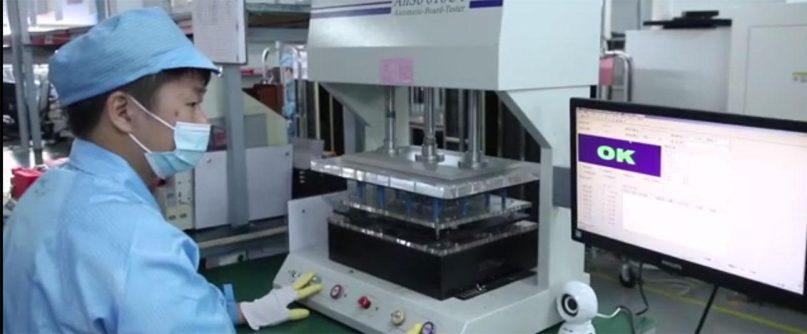
Printed circuit boards (PCBS) are widely used in a variety of electronic devices, whether it is mobile phones, computers or complex machines, you can find circuit boards. If the PCB is defective or has a manufacturing problem, it may cause the final product to malfunction and cause inconvenience. In those cases, manufacturers would have to recall the devices and spend more time and resources fixing the fault.
Therefore, PCB testing becomes an indispensable part of circuit board manufacturing process.
The so-called PCB inspection is to test the rationality of PCB design, test the problems or defects that may occur in the production process, ensure the functionality and appearance of the product, and improve the yield of the final product.
Generally, PCB inspection can be divided into two categories: manual visual inspection, equipment and instrument inspection.
Electronic Contract Manufacturers (tdt-ele) offer a variety of PCB test methods, but the seven main types include:
· Visual inspection
· In-circuit testing (ICT)
· Flying probe testing(FPT)
· Automated optical inspection(AOI)
· X-Ray inspection
· Burn-in testing
· Functional testing (FCT)
Let’s take a look at the 7 common test methods for PCBs.
1.Visual Inspection
Manual visual inspection is still the most widely used test method. It only requires a low up-front cost, no test fixture requirements, and only one operator equipped with a simple magnifying glass or microscope. This test method can be changed flexibly and can be well adapted to product changes.
Therefore, this test method is still widely used in the major PCB board factories.
Its main shortcomings are: the detection result is affected by the subjective error of the operator, the training cost is high, and the data collection and sorting are difficult.


At present, due to the gradual development of PCB in the direction of precision, customers have higher and higher requirements for product reliability, middle and high end PCB manufacturers began to gradually focus on equipment and instrument inspection.
2.IN-CIRCUIT TESTING (ICT)

ICT, or In-circuit testing, is a must-have testing equipment for modern PCB manufacturers. It is very powerful. It provides a reliable, high fault coverage verification method for all electronic components in PCB components.
It is mainly through the test probe contact PCB layout test point to detect PCBA circuit open, short circuit, all parts of the fault, and clearly inform the staff. Even workers with modest electronics skills can easily deal with faulty PCBs.
It may be performed with a bed of nails type test fixture and specialist test equipment, or with a fixtureless in-circuit test setup.
3. FLYING PROBE TESTING(FPT)

In contrast to traditional testing methods, which place test probes in a fixed position, flying probe testing uses two or more independent probes that operate without a fixed test point (hence the name “flying probe”). These probes are electromechanical and move according to specific software instructions. Therefore, the initial cost of flying probe testing is low, and it can be done by modifying the software without changing the fixed structure.
In contrast, the initial fixture cost of ICT is higher, so flying probe testing is cheaper for small batch orders, but ICT is faster and less error-prone than flying probe testing, so ICT is still more cost-effective for large batch orders.
4. AUTOMATED OPTICAL INSPECTION (AOI)

Automated optical inspection (AOI) is an automated visual inspection of printed circuit board (PCB) (or LCD, transistor) manufacture where a camera autonomously scans the device under test for both catastrophic failure (e.g. missing component) and quality defects (e.g. fillet size or shape or component skew).
It is commonly used in the manufacturing process because it is a non-contact test method. It is implemented at many stages through the manufacturing process including bare board inspection, solder paste inspection (SPI), pre-reflow and post-reflow as well as other stages.
However, AOI will not supply power to the circuit board and cannot detect all components 100%. Therefore, AOI is generally used in combination with other test methods. Commonly used test combinations are:
AOI and flying probe
AOI and ICT
AOI and functional testing
5. X-RAY INSPECTION

X-ray inspection technology, usually referred to Automated X-ray inspection (AXI), is a technology used to inspect the hidden features of target objects or products with X-rays as its source. It is mainly used for the detection of ultra-fine spacing and ultra-dense circuit boards.
Nowadays, X-ray inspection is widely used in lots of applications such as medical, industrial control, and aerospace.
As for PCB inspection, X-ray is massively used in the process of PCB assembly in order to test the quality of PCBs, which is one of the most important steps for quality-oriented PCB manufacturers.
6. BURN-IN TESTING
As the name suggests, the burn-in test is a more intense test of the PCB. It is designed to detect early failures and build load capacity. According to the design requirements, the product is placed under the specific temperature and humidity conditions, continuous simulation work for 72 hours to 7 days, record the performance data, reverse the production process for improvement, to ensure that its performance can meet the market demand.
Due to its strength, burn-in testing may destroy the component under test or shorten the service life of the PCB.
7. FUNCTIONAL TESTING (FCT)


Functional testing simulates the actual operating environment and is carried out in the final stages of production as a final quality control procedure. The relevant test parameters are usually provided by the customer and may depend on the end use of the PCB.
Full 100% functional testing is increasingly being used in small
batches to ensure that every board off the line is functioning properly.
The shortcomings are that writing functional tests programs is complex, time-consuming, and requires trained technicians to analyze the cause of the defect. If you want to get your product to market quickly, this may not be your best choice.
In addition to the above 7 tests, other testing methods are used to further ensure PCB quality based on product requirements, such as solderability tests, PCB contamination tests, Solder float tests, etc.
Which PCB test methods are suitable for you?
Tdt-ele has been specializing in the manufacture and assembly of electronic products for 19 years, with circuit board test qualifications and complete test programs. We will comprehensively determine the use of one or several test combinations for PCB testing according to the requirements of PCB design, use environment, use and production cost.
If you want to know which tests are suitable for your specific needs, come to us and we will give you the most professional advice.
