


In our life, the use of electronic products has been very frequent, basically every field can see its figure. And to these products to play a good effect, the design and processing of the circuit board is very important.
At present, we are using more and more excellent processing technology, among which SMT technology is the best performance, has gained a large degree of popularity.
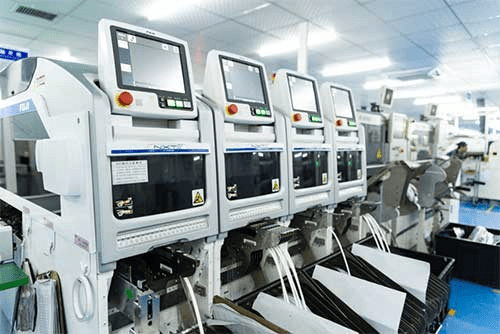
SMT has become the first choice of many electronic component manufacturers, practicality is also praised.
What is SMT (surface mount Technology)?
SMT, short for Surface Mounted Technology, is one of the most popular technologies and processes in the electronic assembly industry.
It is an assembly and production method of attaching electronic components directly to the surface of a printed circuit board (PCB).Unlike traditional assembly, SMT does not require components to be inserted through holes, but rather components are welded directly to the board by reflow soldering.
Under normal circumstances, the electronic products we use are made of pcb plus various capacitors, resistors and other electronic components, according to the design of the circuit diagram. So all kinds of electrical appliances need a variety of different smt patch processing technology to process.
How do you distinguish SMT from SMD?Simply put, SMT is a process in technology and SMD is a device in technology. SMT is a surface mount technology, which refers to the welding of components on PCB by means of patch, and the components welded on PCB are SMDS.
SMT (surface mount technology) machine commonly called pick-and-place machines or P&Ps, are robotic machines which are used to place surface-mount devices (SMDs) onto a printed circuit board (PCB).
What are the steps in the process of SMT manufacturing?
SMT basic process elements include: solder paste printing (or dispensing), mounting (curing), reflow soldering, cleaning, testing, repair.
1. Solder Paste Printing
Its function is to leak solder paste or patch glue onto the PCB pad to prepare for the welding of components. The equipment used is screen printing machine (screen printing machine), located at the front end of the SMT line.
Solder Paste printing process is the common way of applying solder paste onto a PCB, which is performed by printing solder paste through apertures in a stencil.
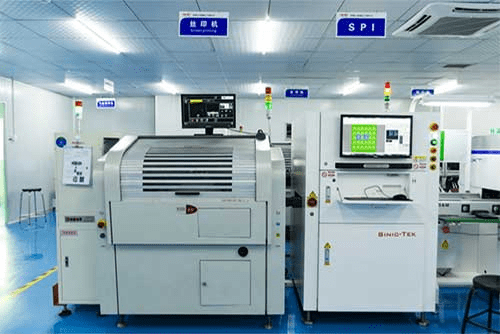
Solder Paste printing process is the common way of applying solder paste onto a PCB, which is performed by printing solder paste through apertures in a stencil.
2.Dispensing
It is to drop the glue to the fixed position of PCB, its main role is to fix the components to the PCB board. The equipment used is the dispensing machine, which is located at the front end of the SMT production line or behind the testing equipment.
3.Mounting
Its function is to accurately install the surface assembly components to the fixed position of PCB. The equipment used is the SMT machine, which is located behind the screen printing machine in the SMT production line.
4.Curing
Its role is to melt the patch glue, so that the surface assembly components and PCB board firmly bonded together. The equipment used is the curing furnace, which is located behind the SMT machine in the SMT line.
5. Reflow welding
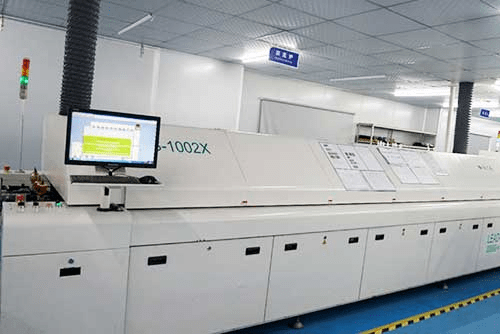
Its role is to melt the welding paste, so that the surface assembly components and PCB board firmly bonded together. The equipment used is reflow furnace, which is located behind the SMT machine in the SMT line.
A reflow oven is a machine used primarily for reflow soldering of surface mount electronic components to printed circuit boards .The oven contains multiple zones, which can be individually controlled for temperature. Generally there are several heating zones followed by one or more cooling zones.
A reflow oven is a machine used primarily for reflow soldering of surface mount electronic components to printed circuit boards .The oven contains multiple zones, which can be individually controlled for temperature. Generally there are several heating zones followed by one or more cooling zones.
6.Cleaning
Its role is to assemble the PCB board above the welding residue harmful to human health, such as flux, etc., to remove. The equipment used is a cleaning machine, the position can not be fixed, can be online or not online.
7.Detection
Its role is to assemble the PCB board welding quality and assembly quality detection. The equipment used includes magnifying glass, microscope, online tester (ICT), flying needle tester, automatic optical testing (AOI), X-RAY testing system, function tester, etc. Location According to the need of detection, can be configured in the production line of the appropriate place.
8.Repair
Its role is to detect the fault of the PCB board rework. The tools used are soldering iron, repair workstation, etc. Configuration anywhere in the production line.
Why do electronic products favor SMT technology?
1.Smaller and lighter.
After using smt processing technology, it is of great help to the lightweight of products. Generally, after SMT is adopted, the size of electronic products is reduced by 40%~60% and the weight is reduced by 60%~80%.
2.More automated, more efficient.
When most people buy electronic products, they attach great importance to its intelligence and automation. Especially with the advent of the era of smart home, household appliances will naturally have better performance in this respect.
Compared with other technologies, SMT processing can provide a better automation space for the circuit board. Moreover, most SMT manufacturing is completed by automatic assembly machines, which is also very obvious for the improvement of production efficiency. Using this technology, electronic patch manufacturing will reduce a lot of labor and material resources, for the enterprise is a lot of benefits, but also a win-win choice for consumers.
3.Good anti-interference effect.
Nowadays, more and more electronic products are used in people’s homes, which brings a problem. That is, each product will interfere with each other, which will have a great impact on the user experience.
The popularity of SMT technology is due to the excellent high-frequency characteristics of the circuit board produced by it, and the anti-interference effect of electromagnetic and radio frequency is very good, basically will not be affected.
Conclusion
Surface mounting technology is a method of mounting electronic components to PCB surface. Its main goal is to reduce manufacturing costs while using PCB space more efficiently.
If you would like more information about SMT, please contact tdt-ele. Tdt-ele was established in 2004, with its headquarters in Shen Zhen. We have advanced SMT machine, can provide you with efficient one-stop service.
