


Wave soldering and reflow soldering are the most common welding methods used in electronic assembly processes. Although both welding methods are used in the manufacture of electronic products, do you know the difference between the two? How do you know which type of welding to use in which situation?
The differences between wave soldering and reflow welding are described in detail below.
What is wave soldering?
As the name suggests, wave soldering is used to combine pcb boards and components through a liquid "wave" formed by stirring the motor. This liquid is actually dissolved tin, which is carried out in a wave soldering machine.
In simple terms, wave soldering is to weld the liquid tin melted at high temperature with the component plug-in of the PCB board. The whole process is automated, faster and more efficient than manual welding. Therefore, it makes wave welding ideal for mass production.
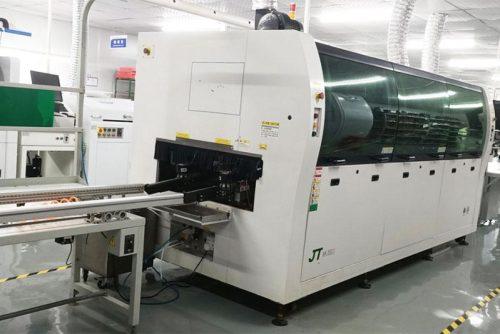
Wave soldering process
The wave soldering process consists of four steps: flux spraying, preheating, wave soldering and cooling.
Flux spraying: The cleanliness of the metal surface is the basis for ensuring welding performance. Spraying solder can remove oxides from the PCB board and also protect the board from secondary oxidation during the thermal process. Spraying flux at the same time can reduce the surface tension of the solder paste and transfer heat.
Preheating: On a tray on a chain similar to a conveyor belt, the circuit board is pre-heated and the flux activated through a heat pipe.
Wave soldering: As the temperature continues to rise, the solder paste becomes liquid, forming waves. The circuit board passes through the "wavy" solder paste to firmly bond the components to the board.
Cooling: After the solder is combined, its internal temperature drops immediately and allows the solder to cool to room temperature before finishing.
What is reflow soldering?
Reflow soldering is the process of using a solder paste (a mixture of solder and flux) to connect one or more electronic components to a contact pad and melt the solder through controlled heating to achieve a permanent joint. Different heating methods can be used for welding, such as backwelding furnaces, infrared heat lamps or heat guns.
The advantages of this process are that the temperature is easy to control, oxidation can be avoided during welding, and manufacturing costs are easier to control.

Reflow process
In the traditional reflow welding process, there are usually four stages, called "zones", each Zone has its own temperature curve: "preheating", "dipping", "reflow" and "cooling".
Electrical components are temporarily attached to a contact pad before soldering with solder paste. Therefore, the real welding will not begin until the preparation work is completed. First, the solder paste is precisely placed on each solder by the solder paste template. The parts are then placed on pads by a selective placing machine.
Preheating: Preheating is the first stage of reflow welding, where the temperature of the entire component assembly climbs to the target immersion temperature. The preheating is mainly to enable the component assembly to safely and gradually reach the working temperature of the immersion heat (pre-reflux temperature), and also to vaporize and volatilize the volatile solvent in the solder paste.
Immersion heating: Immersion heat is usually 60 to 120 seconds of heating, used to remove volatile substances in the solder paste and activate the flux.
Reflow welding: Reflow welding is the stage of the process where the temperature is the highest. The highest temperature is the peak temperature. The common peak temperature is 20 to 40℃ above the solder liquefaction temperature. Temperature monitoring is very important, exceeding the peak temperature may cause damage to the metal grain inside the component, and may cause the formation of metal intercompounds; Too low temperature may cause poor cold welding and reflux of the solder paste.
Cooling: The treated component assembly gradually cools. Once it cools down, the solder paste and parts will be permanently fixed to their contact pads. Proper cooling can inhibit the formation of metal intercompounds or prevent the element from being subjected to thermal shock.
What is the difference between wave soldering and reflow soldering?
The welding process is different: reflow welding is to melt the solder through the circulating air flow in the equipment to weld the components to the PCB. Wave soldering is to melt the welding rod inside the machine through high temperature, so that the components and the solder contact and then welding.
Process complexity is different
Reflow processes are more complex, requiring fine temperature control and unique profiles for different components and sheets. Wave soldering is relatively simple and does not require such a complex temperature profile, but it has certain requirements for the quality of solder, the adjustment and maintenance of wave peaks.
Welding quality is different
Reflow welding allows for better weld quality and lower defect rates, especially for components with fine pin spacing or small size. Wave soldering is prone to some defects, such as virtual welding, bridging and solder ball problems.
The components being welded are different
Reflow welding is mainly used for soldering SMT (surface mount technology) components. Wave soldering is mainly used for the welding of THT (through hole plug-in technology) components.
The fields of application are different
Reflow is suitable for small electronic components and mount components with fine pin spacing, such as QFP, BGA and micro patch components. Wave soldering is mainly used in large plug-in components and some electronic components that can withstand high temperatures, usually those traditional components that are inserted through the holes of the PCB board.
conclusion
In summary, wave soldering and reflow welding are two different welding methods, and both are effective methods for manufacturing PCBAs. There are some differences between them in welding process and application field. Both options have advantages and disadvantages. Therefore, how to choose the appropriate welding method has a great impact on your production and budget.
We hope this article will provide you with some information and help you choose the most beneficial welding method. If you need more help, please feel free to contact us. Tdt-ele will provide you with the highest quality service.
